HOOK
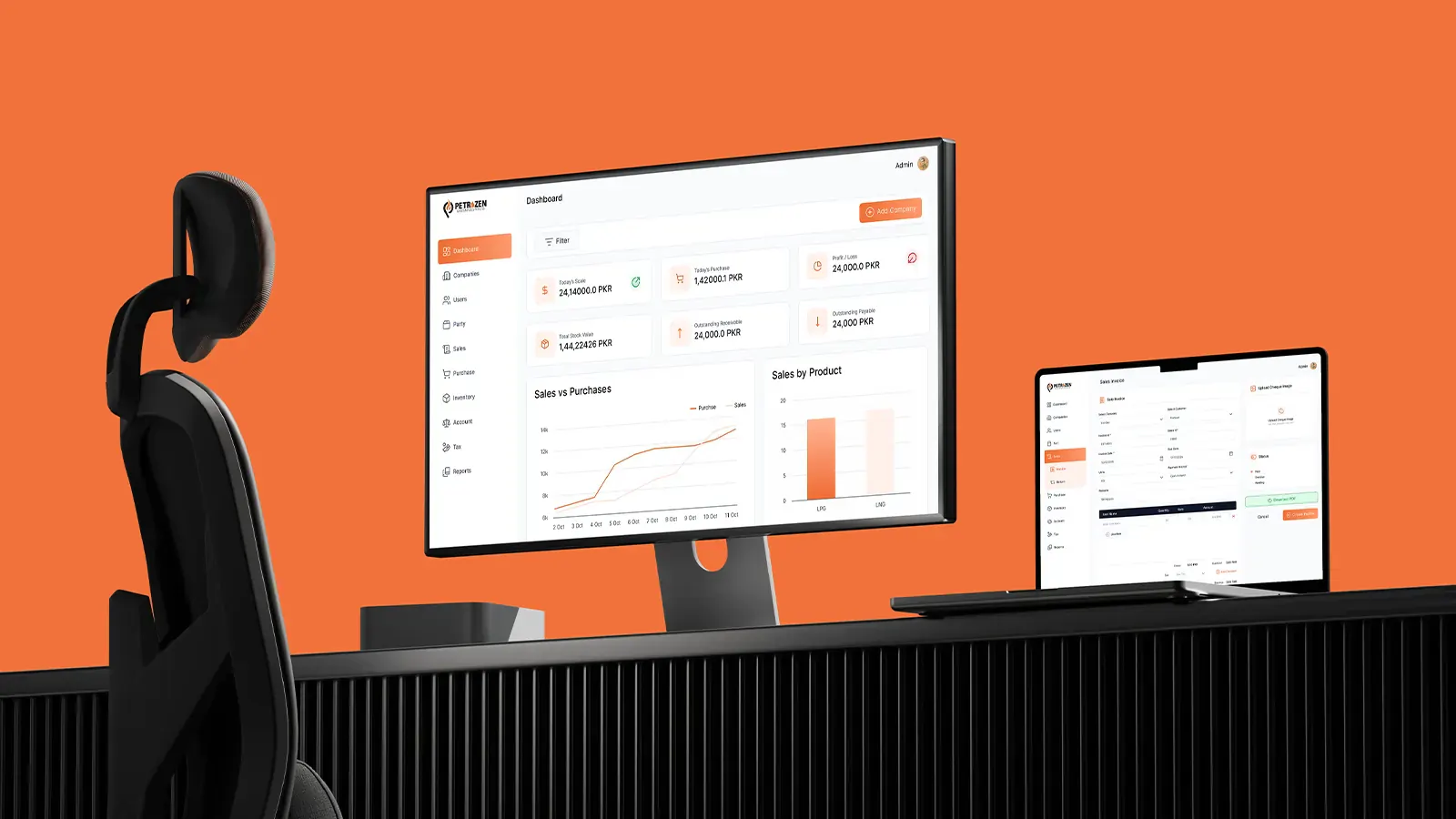
The final product
Invoice-to-reconciliation time dropped by 78% after launch.
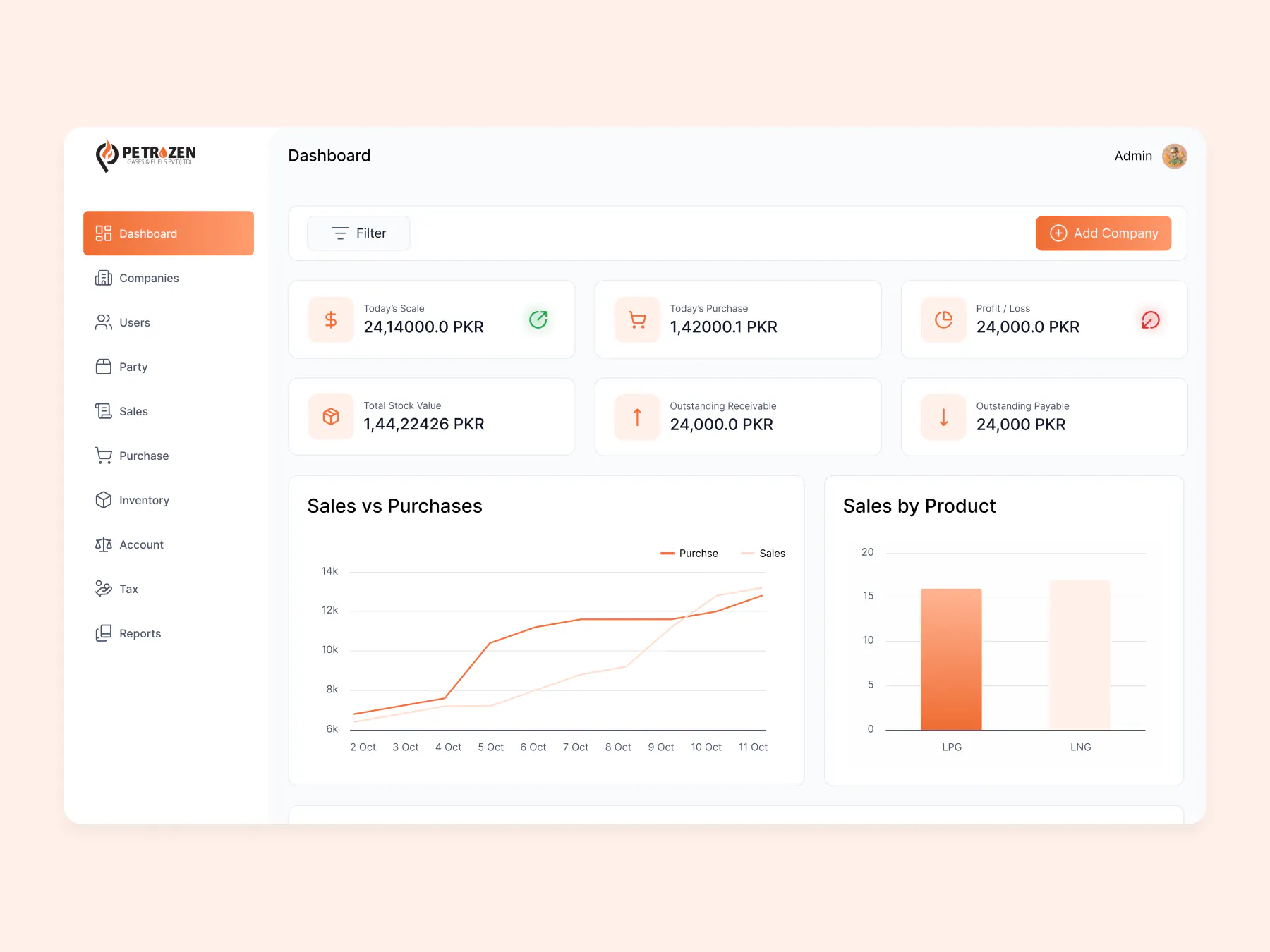
Dashboard Design
High-fidelity final screen of the Petrozen ERP sales and ledger dashboard.
CONTEXT
The brief, the team, the constraints
Petrozen ERP was built for Petrozem group of oil & gass Fuel Trading companies, moving off Excel and manual bookkeeping. The team needed a system where every sale automatically posts to the correct ledger, without users needing formal accounting training.
Tools
THE AI PRODUCT PROBLEM
What was actually broken
Businesses were losing money to manual posting errors, unclear customer balances, and reports that took an accountant days to trust.
“I never know our real outstanding balance until month-end.
“Every invoice is a manual journal entry. One typo breaks the books.
“Our reports don't match our bank statement, and nobody knows why.
Reconciliation gap Traker chart
Manual ledger entries produced recurring mismatches against bank records.
UX RESEARCH
Evidence before opinion
Methods
- 019 contextual interviews with accountants and sales staff
- 022 shadowing sessions during month-end close
- 03Audit of 6 existing Excel-based bookkeeping setups
- 04Audit report not automated, leading to manual reconciliation errors
- 05Sales staff and accountants needed the same data but completely different vocabulary and views
Key findings
- 01Users trusted a system only when every number could be traced back to a source transaction.
- 02The real friction was not data entry, it was fear of an unrecoverable posting mistake.
- 03Sales staff and accountants needed the same data but completely different vocabulary and views.
Key Research Findings
Unpolished clustering from interviews across sales and accounting roles.
USER MENTAL MODELS
Where AI breaks expectations
I mapped where users expected a single "save" action to quietly do the work of a full accountant - invoice, tax split, ledger post, balance update and designed the system to make that automation visible, not invisible.
Invoice-to-ledger expectation map
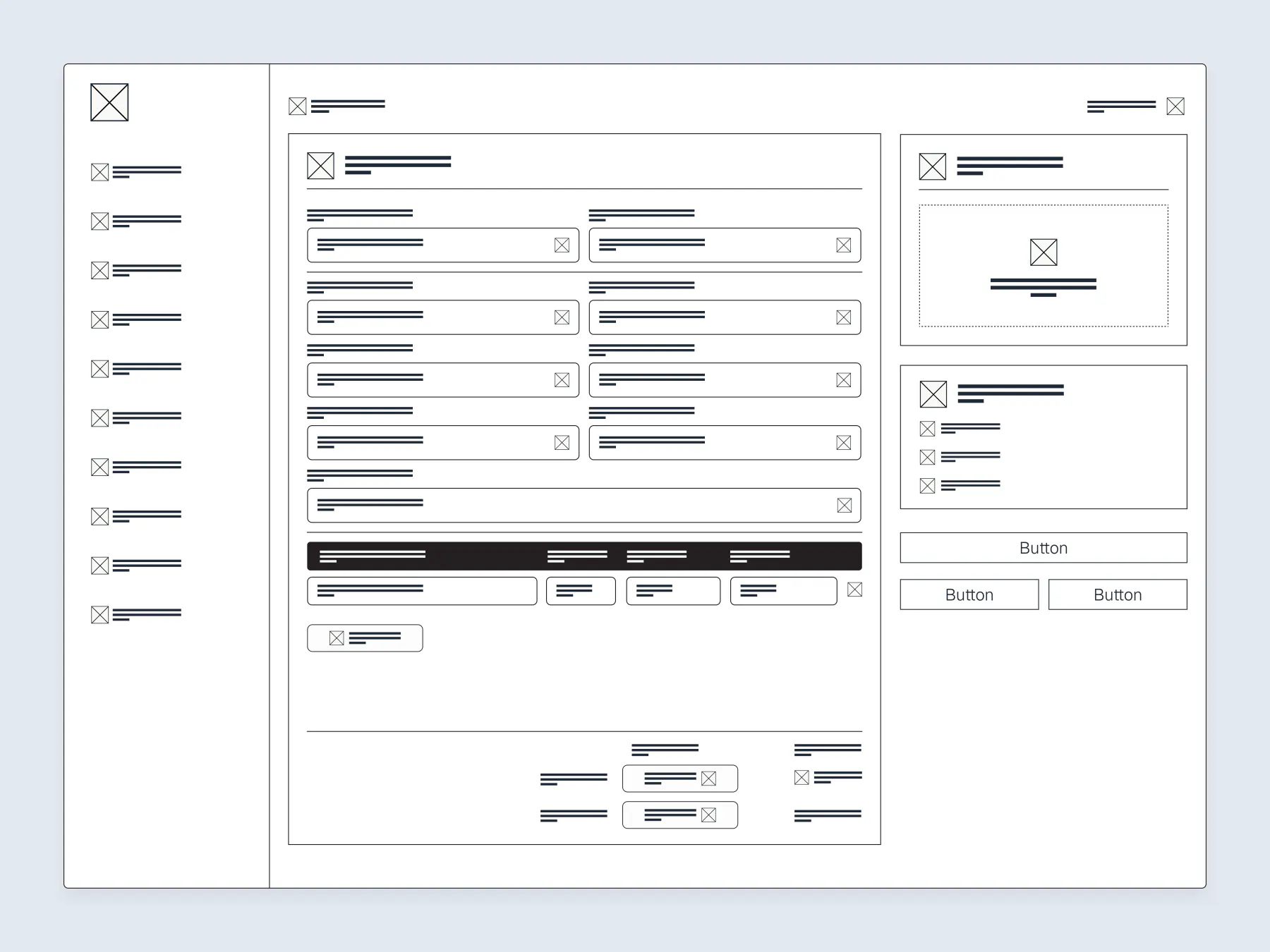
Low-fidelity flow of what users assumed happened behind a single invoice save.
PROBLEM FRAMING
One sharp question
How might we let non-accountants run accurate, audit-ready books without asking them to understand double-entry accounting?
Users expect
Deterministic, evidence-backed answers they can trust on the first read.
AI delivers
Users expect one simple action (save an invoice) to just work; the system actually needs to run tax logic, ledger posting, and balance recalculation correctly every time, with zero silent failures.
DESIGN DECISIONS
Directions considered, choices made
Invoice-to-ledger flow sketch
Pen-style exploration of how one invoice fans out into ledger entries.
Outstanding balance placement studies
Whiteboard mapping of where customer balance should surface across screens.
Admin flow sketch
Admin authority and flow around the syetem.
Density exploration wall
Information-density variations explored on the design wall.
Rejected
Let users manually create journal entries for every transaction
Chosen
Automatic double-entry posting triggered by business documents (invoice, payment, receipt)
Manual journaling gave power users flexibility but caused unrecoverable errors for everyone else. Auto-posting from familiar business documents kept the books correct by construction.
THE WORK
From structure to final pixels
Walk the invoice, ledger, and reporting flows in the working Figma file.
invoice.status.*
4 status states, Draft, Paid, Pending, Overdue.
ledger.entry.*
Debit/credit entry chips with source-document traceability.
balance.indicator.*
Color-coded outstanding balance indicators by risk level.
- 01Ledger posting confirmation animates in at 150ms to make the auto-post action visible, not invisible.
- 02Balance updates use a 200ms count-up transition so users see the number actually change.
AI UX PATTERNS
Designing for uncertainty
State cluster component set
Closeups of the draft, posted, overdue, and reconciled states.
Invoice is editable and has not posted to any ledger.
Ledger entries locked; edits require a linked credit note.
Surfaces on customer outstanding report with due-date aging.
Shows remaining balance after partial payment allocation.
Confirms ledger balance matches bank/cash statement.
Payment exceeds invoice balance
Excess automatically routes to customer advance balance instead of blocking the transaction.
Invoice edited after posting
System blocks direct edits and prompts a credit note, preserving audit trail integrity.
USABILITY TESTING
What changed after real users
Session replay highlight
Before
After
Change
Before
Month-end reconciliation took an average of 3.5 days.
After
Auto-posted ledgers reduced reconciliation to under 1 hour.
Change
Replaced manual journal entry with document-triggered double-entry posting.
Click concentration
Attention concentrated on the evidence rail after launch.
OUTCOME
The measurable result
RECONCILIATION_TIME
<1 HR
from 3.5 days
POSTING_ERRORS
0.4%
from 11%
REPORT_TRUST_SCORE
4.7/5
from 2.5/5
Final product in context
The shipped sales and ledger cockpit in daily use.
REFLECTION
Honest takeaways
I learned that trust is the product in AI workflows. Accuracy alone did not move behavior. What changed behavior was explicit evidence, transparent confidence language, and graceful recovery when the model failed.
What I'd do next
- 01Run longitudinal trust tracking over 90 days.
- 02Introduce adaptive confidence phrasing by task criticality.